

Preparing VAT software for mandatory e-invoicing: What UK businesses must do now
- No credit card required
Talk to our VAT experts
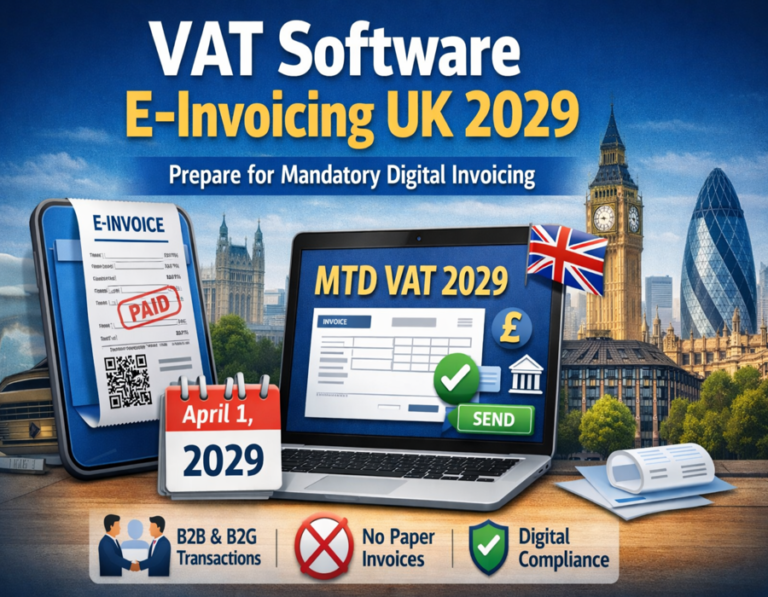
There is a clear deadline for businesses. At Budget 2026, HMRC will set out a thorough plan, and work with stakeholders will start in January 2026. This allows you time to get used to things, but waiting until the last minute could mean making changes too quickly and spending more money.
Why mandatory e-invoicing matters for VAT in the UK
- The change is based on the Making Tax Digital for VAT initiative. By upgrading its data, it hopes to reduce manual work, errors, and payment processing time, and to close the VAT gap.
- E-invoicing is optional for now. HMRC now accepts PDFs as electronic invoices, but the 2029 rules require structured formats such as XML or similar standards for direct system-to-system exchange.
- No real-time reporting to HMRC is required at launch. The focus stays on invoice format, quality, and interoperability between businesses. This differs from some EU models with live submission.
- VAT-registered businesses issuing or receiving invoices to other UK VAT-registered entities or public bodies must comply. B2C invoices are likely to remain outside the initial scope.
HMRC e-invoicing requirements for VAT: What changes in 2029
- From April 2029, all VAT invoices in scope must use an approved structured format. This means data fields for supplier details, customer information, invoice number, date, VAT amounts, and line items, all in machine-readable form. PDFs, Word docs, scanned images, or HTML won’t qualify as compliant e-invoices.
- Businesses need systems that generate, send, receive, and store these structured documents. Integration with accounting or ERP software becomes essential. For compliance, you can’t enter information manually or attach files to emails.
- Later, the government will set specific criteria, likely based on international standards such as PEPPOL or EN 16931, to ensure they work across borders.
Prepare VAT software for e-invoicing: Steps to take now
- Start assessing your current setup. Many VAT software solutions can help you file your MTD, but structured e-invoicing may not be one of them yet.
- See if your provider has plans to make changes in response to the 2029 mandate. Ask about expenses, timelines, and how they will deal with organised formats. If you switch providers later, you might have trouble moving your data.
- Businesses comparing future-ready systems should also review the differences between VAT online software and bridging tools before choosing a long-term MTD solution.
- Look over the process for sending invoices. Identify manual steps that structured e-invoicing can automate.
- Test integration options. Look for software with API connections to accounting systems. This helps automate data pull for invoice creation.
- Build a timeline. Use 2026 for detailed planning once the roadmap appears. Budget for upgrades, training, and possible new tools.
Future-proof VAT software for UK businesses
- Find VAT software that meets both the current MTD requirements and the new e-invoicing rules. Cloud-based choices usually get updates faster than on-premises ones.
- Put features like automatic VAT calculation, safe data storage, and quick export for HMRC submissions at the top of your list. By 2029, being able to work with organised forms will be the most important thing.
- Think about how scalable it is. Tools that can handle more work without extra effort help grow firms.
- Check for safety. To keep critical VAT information safe, structured data exchange needs strong encryption and access controls.
Structured electronic invoicing for VAT: benefits & challenges
- Structured formats speed up processing. Recipients can import data directly into their systems, which speeds up the reconciliation process.
- Validation is automatic, reducing the number of errors. Early warnings are sent out for duplicate invoices or missing fields.
- Cash flow improves with quicker approvals and payments. Using less paper helps the environment.
- Challenges include upfront costs for software upgrades. Smaller businesses may need help with setup. Staff training takes time.
- Legacy systems might not integrate well. Data migration from old formats requires care to avoid loss.
Mandatory e-invoicing VAT software: How to choose wisely
- Look for providers experienced in HMRC compliance. They should track policy changes and update accordingly.
- Check for tools that have solid support. Stress levels go down when there are clear directions, live help, and update notifications.
- Look at the VAT return software features and prices side by side. Think about how automation can save you money in the long run.
- Read what users say about its reliability during busy filing times.
- If you manage more than one VAT registration, make sure the software can handle multiple businesses.
What UK businesses must do before 2029
- Keep an eye on official news. For updates on HMRC’s roadmap and standards, visit GOV.UK.
- Join industry groups or forums to gain ideas from others in your field.
- Look at the quality of your invoice data through internal audits. Clean records make the change go more smoothly.
- Speak with accountants or experts about how this will affect your setup.
- Please try structured invoicing with suppliers or customers who are willing to participate.
- The 2029 deadline gives you some time. Businesses that plan don’t have to rush at the last minute and can run their businesses more smoothly.
- This adjustment brings the UK in line with digital Tax developments in other countries. It promotes efficiency and makes it easy to follow the rules once the systems are in place.
Disclaimer: Our blogs and articles are written to share general information only. If you’re looking for an easy way to submit your VAT under Making Tax Digital (MTD), SwiftVATPro offers a simple and reliable online solution.
Frequently Asked Questions:
Your Questions – Answered ,We’re here to help you with anything VAT-related.
1. What is mandatory e-invoicing for VAT in the UK, and when will it start?
Businesses will have to send and receive invoices in a structured electronic format via suitable digital systems, rather than using paper documents or basic PDF invoices. The UK government indicated in the Autumn Budget 2025 that this rule will apply to business-to-business (B2B) and business-to-government (B2G) transactions involving VAT from April 1, 2029.
Under this system, invoices must be created using software that generates machine-readable formats such as XML or similar standards. These formats allow systems to automatically exchange invoice data between businesses, improving accuracy and efficiency. The goal is to modernise the Tax process, reduce manual errors, and help close the UK VAT gap.
E-invoicing is not required right now, but businesses could start preparing by reviewing their invoicing systems and VAT software. If you take action before the deadline, the change will go more smoothly, and you won’t have to make upgrades or pay for things you didn’t anticipate as 2029 approaches.
2. Will PDF invoices still be allowed under the UK e-invoicing rules?
No, common PDF invoices won’t work until e-invoicing becomes required in April 2029. HMRC now accepts PDFs as electronic invoices, but the new standards will require structured invoice data that systems can read and process automatically.
A structured invoice includes fields such as supplier and customer information, invoice numbers, VAT amounts, and line-item data. It is in a format that computer systems can read, like XML. These formats let software check and send invoice data directly between systems, which isn’t possible with PDFs or scanned documents.
This change is designed to reduce errors caused by manual data entry and speed up processing between businesses. Businesses that still use PDFs or handwritten invoices will need to switch to VAT or accounting software that supports structured e-invoicing.
3. How should businesses prepare their VAT software for mandatory e-invoicing?
Businesses should start by reviewing whether their current VAT or accounting software can support structured e-invoicing formats. Many tools already support Making Tax Digital (MTD), but not all of them are ready for the upcoming e-invoicing requirements.
First, check with your software provider about their plans to support structured invoice formats, such as XML or PEPPOL standards. Understanding upgrade timelines and potential costs will help you plan your transition.
Next, examine your invoicing process. If invoices are created manually or involve multiple manual steps, those areas may need automation. Integration between invoicing tools and accounting software will become increasingly important.
4. What are the benefits of structured electronic invoicing for businesses?
Structured electronic invoicing offers several practical advantages for businesses once the system is in place. One of the biggest benefits is automation. Because invoice data is machine-readable, it can move directly between systems without manual entry, reducing errors and saving time.
Another major advantage is faster processing and reconciliation. Businesses that receive structured invoices can enter the information directly into their accounting software, speeding up the approval and payment process.
It’s also better to check. Before sending, systems can automatically check invoices for missing information, duplicate entries, or inaccurate VAT calculations. This helps businesses keep their books in order and avoid breaking the law.
5. How can businesses choose the right VAT software for e-invoicing compliance?
Choosing the right VAT software is key to preparing for the UK’s new e-invoicing laws. Before 2029, businesses should look for solutions that already comply with Making Tax Digital (MTD) and have clear plans to implement the structured e-invoicing requirements.
A good starting point is to check whether the software can generate and exchange machine-readable invoice formats, integrate with accounting systems, and automate VAT calculations. Cloud-based platforms are often a practical option because they receive regular updates as Tax regulations change.
Security is another key factor. Since structured invoicing involves digital data exchange, the software should provide strong encryption and access controls to protect sensitive financial information. Businesses should also consider scalability and support services. As companies grow or manage multiple VAT registrations, their software must handle increasing workloads.