
Free tool
Margin scheme VAT calculator
For an eligible item at the 20% rate, under the standard margin scheme. A general guide based on GOV.UK guidance, not advice.
What is the VAT margin scheme?
The margin scheme is a way of accounting for VAT on second-hand goods, works of art, antiques and collectors’ items. Instead of charging VAT on the full price you sell an item for, you pay VAT only on the difference between what you paid for it and what you sold it for. That difference is your margin.
The VAT rate under the scheme is 16.67%, which is the same as one-sixth of the margin. So if your margin is £600, the VAT you owe HMRC is £100.
It is optional, and you decide item by item. You can put one sale through the margin scheme and handle another under normal VAT rules if that suits you better.
How do you start using the margin scheme?
You do not need to tell HMRC in advance or fill in a separate application. If your goods and records meet the rules, you start using the scheme by keeping a proper stock book and invoices, then include the margin scheme figures on your normal VAT return.
If your records do not meet HMRC’s requirements, you may have to account for VAT on the full selling price instead. So it is worth getting the paperwork right from your first eligible purchase.
A worked example
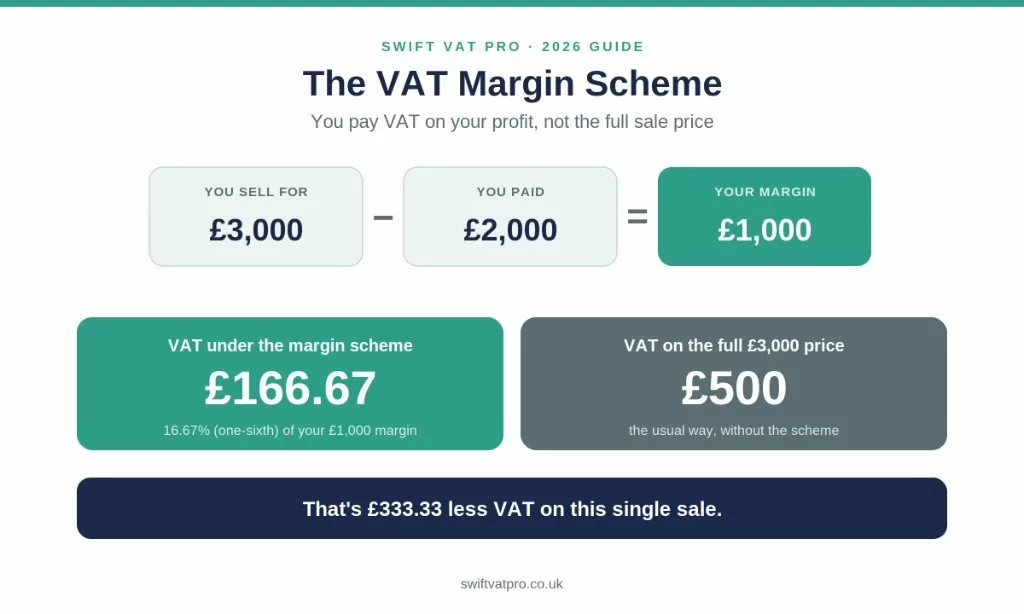
Say you buy a second-hand item for £2,000 and sell it for £3,000.
Your margin is £1,000. The VAT you owe is one-sixth of that margin, which is £166.67.
Without the scheme, if that £3,000 selling price is treated as VAT-inclusive under the normal rules, you would account for VAT at one-sixth of £3,000, or £500. So on this single sale the margin scheme saves you £333.33 in VAT. Multiply that across a year of stock and you can see why dealers in used goods rely on it.
What can you sell under the scheme?
You can use a margin scheme for:
- Second-hand goods
- Works of art
- Antiques
- Collectors’ items
You cannot use it for:
- Any item you were charged VAT on when you bought it, or were entitled to reclaim VAT on. The scheme only works because there was no VAT to recover in the first place.
- Precious metals
- Investment gold
- Precious stones
A quick test: if you bought the item on a normal VAT invoice and reclaimed the VAT, that item stays on standard rules when you sell it. If you bought it from a private individual, a dealer using the margin scheme, or anyone who did not charge you VAT, it can go through the scheme.
The trade-offs worth knowing before you start
The margin scheme saves VAT, but it comes with conditions that catch sellers out. Three are worth knowing up front.
You cannot reclaim VAT on the stock you buy for the scheme. That is by design, because there was no VAT charged to you anyway. You can still reclaim VAT on your business overheads, repairs, parts and accessories in the normal way. You just cannot add any of those costs to the purchase price when you work out the margin.
Your sales invoice must not show VAT separately. Under the scheme you are not allowed to itemise the VAT, which means a VAT-registered buyer has nothing to reclaim. If you mostly sell to other businesses that want to recover VAT, a normal VAT invoice may serve them better, so weigh that up before you default to the scheme.
You cannot offset a loss against a profit. If you sell one item for less than you paid, there is no VAT to pay on that sale, but you cannot use that loss to reduce the VAT on an item you sold at a profit. The one exception is global accounting, covered below.
Records HMRC expects you to keep
The margin scheme runs on good records. If you cannot show how you worked out the margin, HMRC can make you account for VAT on the full selling price instead, so this part matters.
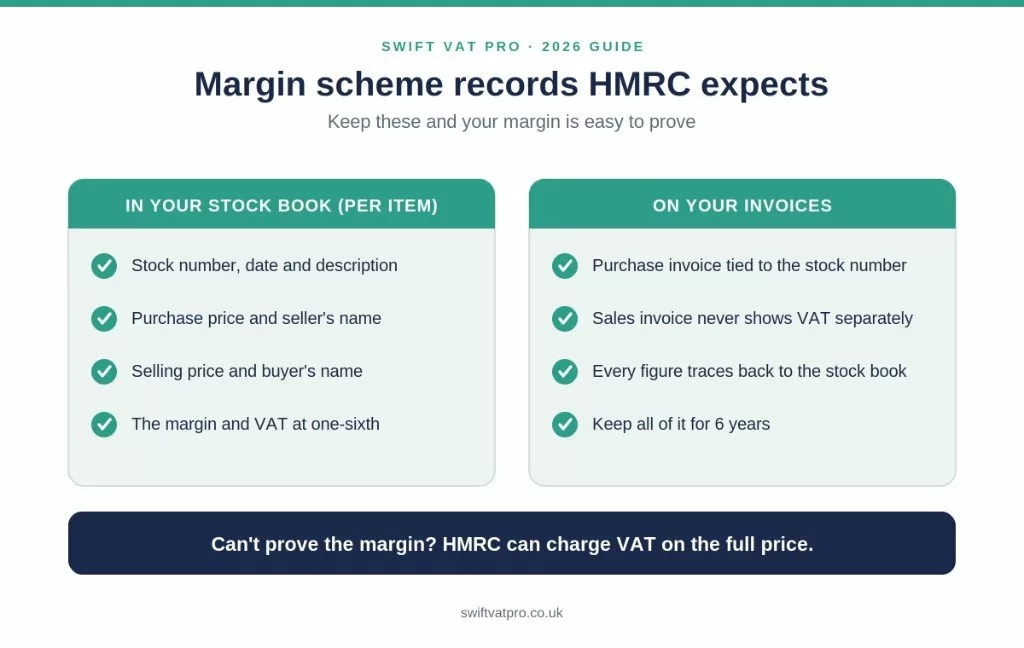
You need to keep a stock book that tracks each item individually. For every purchase, record the stock number, the date, the purchase invoice number, the price you paid, the seller’s name and a description. For every sale, record the date, the sales invoice number, the selling price, the buyer’s name, the margin, and the VAT due at one-sixth.
Your purchase and sales invoices need to tie back to that stock book. On a sales invoice you must not show VAT as a separate figure. Keep all of it for six years, the same as your other VAT records.
What must appear on margin scheme invoices?
HMRC is specific about invoice wording. Getting this wrong is one of the most common reasons sellers fall out of the scheme.
On a sales invoice, you must not show VAT separately. You must also include the correct margin scheme statement for the type of goods, for example “Margin scheme - second-hand goods”, or the equivalent for works of art or collectors’ items and antiques.
On a purchase invoice, keep the stock number, a clear description, the price you paid, and the seller’s details. If you bought from another VAT-registered dealer using the margin scheme, the invoice should carry the matching margin scheme statement.
Full detail is in HMRC’s guidance on keeping records for VAT margin schemes.
Global accounting: the simpler version for bulk sellers
If you deal in high volumes of low-value items, tracking every single one through a stock book is a burden. Global accounting is a simplified version of the margin scheme built for exactly that.
Instead of working out the margin item by item, you work out VAT on the difference between your total purchases and total sales of eligible goods in each VAT period. It also lets you offset losses against profits across your stock, which the standard scheme does not.
There are limits. Any individual item with a purchase value over £500 cannot go through global accounting, and some goods are excluded whatever they cost: aircraft, boats and outboard motors, caravans and motor caravans, horses and ponies, and motor vehicles unless they are broken up for scrap.
Second-hand cars and other vehicles
Car dealers have their own version of the margin scheme for used vehicles, and it comes with extra record-keeping around each vehicle. If you buy and sell second-hand cars, vans or motorcycles, the principle is the same - you pay VAT on the margin - but the detailed rules sit in separate HMRC guidance. It is worth reading that alongside the general scheme rather than assuming the standard steps cover you. See using the VAT margin scheme for second-hand vehicles on GOV.UK.
Is the margin scheme right for you?
As a rough guide, the scheme is a strong fit if you buy stock from private individuals or other non-VAT sources, you sell mainly to consumers, and your margins are healthy. That covers a lot of antiques dealers, second-hand and vintage sellers, art and collectibles traders, and used-vehicle dealers.
It is less useful if you were charged VAT on the goods when you bought them, or if you sell mostly to VAT-registered businesses who would rather have a normal VAT invoice to reclaim against. There is no turnover limit either way, so the decision comes down to how you buy and who you sell to.
How do you report margin scheme VAT on your return?
Margin scheme VAT goes on your normal VAT return. You do not file a separate return, but boxes 1, 6 and 7 follow special rules for your margin scheme goods:
- Box 1: the VAT due on the margins of all eligible goods you sold in the period, at one-sixth of each margin.
- Box 6: the full selling price of all eligible goods you sold in the period, less the VAT due on the margin. Not just the margin.
- Box 7: the full purchase price of the eligible goods you bought in the period, whether or not you have sold them yet.
- Boxes 8 and 9: you do not need to include margin scheme purchases or sales.
Sales and costs outside the scheme go on the same return in the normal way. You can still reclaim VAT in Box 4 on overheads, repairs, parts and accessories, but not on the margin scheme stock itself.
Example: in a quarter you sell margin scheme goods for £30,000 that cost you £21,000, and buy £18,000 of new stock. Your total margin is £9,000, so Box 1 includes £1,500, Box 6 includes £28,500 (£30,000 − £1,500) and Box 7 includes £18,000.
Under Making Tax Digital, these totals come from your stock book. See how to file your VAT return through Making Tax Digital.
Your stock book is already a spreadsheet. File from £5 a month
Margin scheme dealers already keep a stock book. Add up the period's margins, sales and purchases, and Swift VAT Pro sends your VAT return to HMRC through Making Tax Digital.
- Total the VAT on your margins for Box 1, your selling prices less that VAT for Box 6, and the stock you bought for Box 7.
- Add any sales and costs outside the scheme in the normal way.
- Upload your nine box totals as a CSV. Swift VAT Pro works out Box 3 and Box 5.
- Submit to HMRC and keep the receipt.
No card needed · From £5 a month · Filing through HMRC's MTD service since 2019
Getting your VAT right
The margin scheme is one of the most useful reliefs going for anyone trading in second-hand goods, as long as your records back up every figure. Keep your stock book up to date, use the right invoice wording, and put each figure in the right box on your VAT return. If you work from spreadsheets, MTD VAT bridging software files your return without full accounting software.
It can also be worth reading our guides on UK VAT rates and the Flat Rate vs Standard scheme so you can compare your options.
For the latest rules, check the official GOV.UK guidance: VAT margin schemes, keeping records, and using the global accounting VAT margin scheme.
Disclaimer: This guide is general information, not tax advice. Whether a VAT scheme suits your business depends on your own circumstances, so check the latest HMRC guidance or speak to a qualified adviser before using or leaving a scheme.
Frequently asked questions
Checked against GOV.UK "VAT margin schemes" (eligibility, keeping records and VAT return), HMRC guidance on the Global Accounting scheme and VAT Notice 700/12. November 2026.
How is VAT worked out under the margin scheme?
What goods can you sell under the margin scheme?
Can you reclaim VAT on stock you buy for the scheme?
Do you have to use the margin scheme on every sale?
Do you need to register for the VAT margin scheme?
What is the global accounting scheme?
Do second-hand car dealers use the margin scheme?
Where does margin scheme VAT go on my VAT return?
Your stock book is already a spreadsheet. File your margin scheme VAT return from £5 a month.
Swift VAT Pro files your return to HMRC from the spreadsheet you already keep. From £5 a month.
No card needed · 2,900+ VAT returns filed since 2019