

A Guide to VAT on commission payments in the UK
Many companies in the UK handle VAT on a commission basis. Brokers, estate agents, recruitment consultants, and independent contractors frequently receive commissions, which may be subject to VAT.
Talk to our VAT experts

This guide covers common errors, filing under Making Tax Digital, when to charge VAT on commission, and how to recover VAT on commission expenses.
What is VAT on commission?
- Commission is the amount an agent or middleman earns for facilitating a deal or providing a service. In most cases, VAT-registered businesses in the UK are required to charge VAT on commissions at 20%.
- For example, an estate agent charging £5,000 commission would add £1,000 VAT, bringing the total to £6,000. VAT must be shown separately on invoices.
- Businesses paying a commission may also reclaim VAT on expenses if the supplier is VAT-registered and the cost relates to taxable business activities.
When to charge VAT on commission
Domestic UK commission VAT transactions
- Property and estate agents
- Recruitment agencies
- Insurance brokers
- Freelancers and consultants providing services in the UK
Cross-border commission VAT considerations
- Services provided to businesses outside the UK are usually outside the scope of UK VAT
- Services received from overseas agents may be subject to reverse charge rules.
- It is essential to identify the place of supply accurately to prevent errors.
Exempt commissions
- Financial services, loans, and insurance
- Certain legal services
How to reclaim VAT on commission expenses
Businesses paying commission can reclaim VAT if:
- The commission relates to taxable business activities
- The supplier is VAT registered in the UK
- VAT is shown separately on the invoice
- Example: An agent receives £1,000 from a recruitment agency plus £200 VAT. The company can claim the £200 VAT if it is registered for VAT
- Reclaiming VAT can improve cash flow. Keeping accurate records of all invoices, payments, and VAT charges is essential.
Common mistakes with commission VAT
- Not charging VAT on domestic commissions
- Considering foreign commissions to be exempt rather than outside the scope
- Not remembering to claim VAT on commission costs
- Insufficient records or manual processes that increase the chances of errors in VAT filing
Since April 2022, all VAT-registered businesses in the UK have been required to file their VAT returns digitally under the Making Tax Digital (MTD) initiative.
MTD requires businesses to:
- Keep digital records of VAT
- Submit VAT returns using compatible software
- Ensure VAT on commission is correctly reported
Many businesses still calculate VAT on commission in spreadsheets. VAT bridging software enables spreadsheet data to be submitted directly to HMRC, thereby reducing errors and simplifying the filing process.
Managing VAT on commissions for various business structures
Agents acting on behalf of principals
- If a business uses an agent, VAT is calculated on the fee the agent earns, not on the total amount of the deal.
- Example: An estate agent sells a property for £200,000 and earns £5,000 commission. VAT is applied to the £5,000 commission, not the £200,000 sale.
Principal businesses paying VAT on commission
Entrepreneurs and independent contractors
Freelancers who receive commission and are VAT-registered must account for VAT. They should maintain accurate records for their return and issue invoices that clearly show the VAT amount.
Best practices for VAT on commission
- Check if VAT applies depending on the type of commission and the client’s location
- Keep clear invoices that show VAT and commission separately
- Use digital records to comply with MTD
- Reconcile all commission payments before filing VAT returns
- Follow HMRC guidance on place of supply and exempt services to avoid mistakes
Bridging software
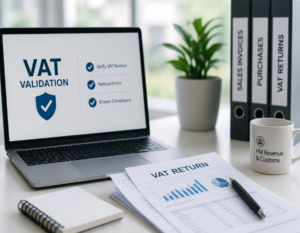
Businesses can file VAT returns online using HMRC-recognised bridging software. It helps send records directly to HMRC and ensures MTD compliance. The software does not calculate VAT but simplifies the submission process.
Conclusion
- Charge VAT correctly on UK commissions
- Follow the place of supply rules for overseas clients
- Reclaim VAT only when allowed
- Keep accurate digital records
Frequently Asked Questions:
Your Questions – Answered ,We’re here to help you with anything VAT-related.
1. Do all businesses need to charge VAT on commission payments??
Not every business is required to charge VAT on commission payments. The rules depend on whether the company is VAT-registered and what type of services it provides. For example, estate agents, brokers, or consultants who are VAT-registered generally need to add VAT to their commission invoices. However, some services, such as insurance or certain financial products, are exempt, meaning no VAT is applied.
However, some services, such as insurance or certain financial products, are exempt, meaning no VAT is applied. Cross-border transactions add another layer of complexity, as the place of supply rules determine where VAT is due.
If a UK agent provides services to a business outside the UK, the payment may fall outside the scope of UK VAT. The key is to identify whether the activity is taxable, exempt, or outside scope before raising invoices. This ensures the correct treatment and avoids penalties for undercharging or failing to declare Commission VAT in digital returns.
2. Can businesses reclaim VAT on UK commissions they pay?
Yes, businesses can often reclaim VAT on UK commissions they pay, provided certain conditions are met. First, the commission must be linked to taxable business activities. For example, suppose a recruitment agency charges a business £1,000 plus VAT for hiring services. In that case, the company may be eligible to reclaim the VAT if it is VAT-registered and uses the service for taxable supplies.
The supplier must also be VAT-registered, and the invoice must clearly display the VAT amount separately. Proper documentation is essential because HMRC requires accurate digital records under the Making Tax Digital (MTD) initiative. If the commission relates to exempt activities, such as certain financial or insurance transactions, VAT cannot be reclaimed.
Businesses should also check if partial exemption rules apply. Reclaiming VAT correctly helps with cash flow and ensures compliance. Keeping invoices and reconciliation up to date will make it easier when filing Commission VAT returns digitally.
3. How are overseas commission payments treated for VAT purposes?
When it comes to cross-border transactions, VAT on UK commissions can be complex and not always straightforward. The treatment depends on the customer’s location and whether they are a business or an individual. If the recipient is a business located outside the UK, the payment is usually outside the scope of UK VAT.
This means that the UK agent does not add VAT to the invoice; however, the overseas client may be required to account for VAT under local rules. On the other hand, if the client is an individual based abroad, UK VAT may still apply. Businesses must carefully apply the place of supply rules to determine where VAT is due.
Errors in this area are common, especially with digital services or complex contracts. Keeping clear records of the client’s location and status helps prevent issues. Using digital software also ensures the VAT Commission rules are applied correctly for international transactions.
4. What are the most common mistakes with Commission VAT?
Common mistakes with Commission VAT include not charging VAT when required, misclassifying exempt transactions, and failing to reclaim VAT on eligible costs. For example, some businesses incorrectly assume all foreign commissions are exempt, when in fact they are often “outside scope,” which requires different reporting.
Another frequent issue is using manual spreadsheets without digital links, which increases errors under MTD requirements. Businesses also sometimes forget to issue invoices that clearly separate commission fees and VAT amounts. This can cause trouble during HMRC checks. Additionally, failing to reconcile commission payments before filing a VAT return may result in under-reporting or over-claiming input Tax.
Avoiding these mistakes requires proper training, accurate record-keeping, and the use of HMRC-recognised software. Correctly managing VAT on UK commissions not only prevents fines but also enhances transparency and ensures returns are filed on time, eliminating the need for unnecessary corrections.
5. How does Making Tax Digital affect commission-based businesses?
Making Tax Digital (MTD) has changed the way businesses report VAT, including those that earn or pay commissions. Since April 2022, all VAT-registered businesses have been required to maintain digital records and submit returns through HMRC-compatible software. For commission-based industries, such as estate agents, recruitment firms, or freelance consultants, this means they must log invoices and payments in digital format.
While many still calculate commission VAT in spreadsheets, these files must be digitally linked to submission software rather than copied manually. Bridging software is often used to connect spreadsheets to HMRC without needing a full accounting system
The aim is to reduce errors, increase accuracy, and keep tax reporting transparent. Failure to follow MTD rules could lead to penalties. By ensuring that Commission VAT is tracked digitally, businesses simplify compliance and avoid mistakes that could otherwise delay submissions or trigger HMRC reviews.